
No single subscription ever feels like the problem. $9.99 here, $12.99 there — each one is small enough to not think twice about. The problem shows up only when they're all listed on one page at the same time, which is exactly why most people never actually do it.
What Subscription Creep Actually Looks Like
Subscription creep is the slow accumulation of small recurring charges — streaming, apps, trials that were never cancelled — each added separately over months or years, none of them individually large enough to trigger a second look. Here's a realistic seven-item list and what it adds up to:
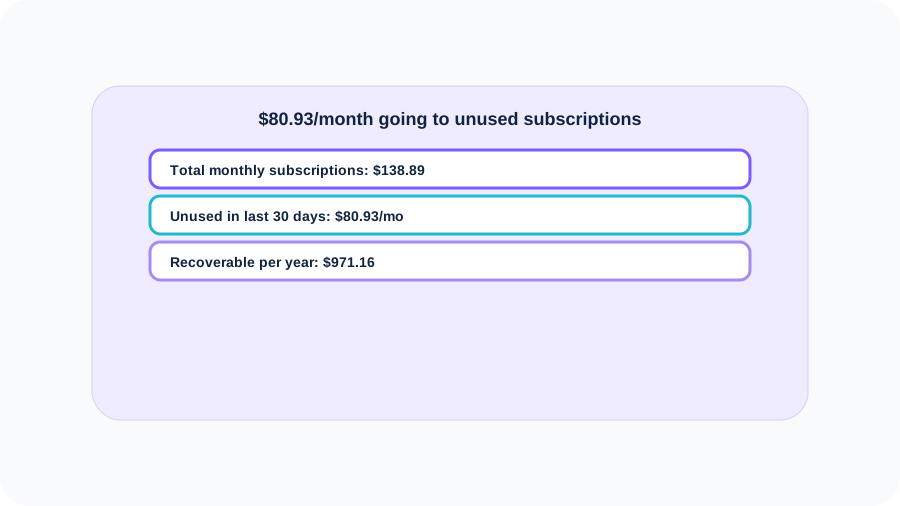
Streaming video $15.99, streaming music $11.99, cloud storage $9.99, a meal kit trial that was forgotten $59.94, a fitness app $19.99, a news subscription $8.00, and a design app that hasn't been opened in months at $12.99. Individually, none of these looks alarming. Added together: $138.89 a month, or $1,666.68 a year.
Step-by-Step: Running a 15-Minute Subscription Audit
Pull the last 60 days of bank and card statements — two months catches monthly charges twice and quarterly charges at least once. List every recurring charge on one page, no matter how small, including free trials that converted to paid. Next to each one, mark whether it was actually used in the last 30 days, not whether it might be used someday. Cancel anything marked unused on the spot, before moving to the next line — delaying cancellation is exactly how items stay on the list for another billing cycle.
Consumer finance guidance from the CFPB's spending tracker tools recommends this same two-week-to-one-month statement review as the starting point for any budget audit, since a short review window is what actually gets finished, unlike an open-ended "review my spending sometime" task that tends to get postponed indefinitely.
The Real Cost of "I'll Cancel It Later"
In the example above, three of the seven subscriptions — the meal kit trial, the news subscription, and the unused design app — hadn't been used in the last 30 days: $80.93 a month combined. Over a year, that's $971.16 spent on services providing zero current value, not because any single decision was bad, but because none of them were ever revisited after the initial sign-up.
Where to Redirect the Savings
The $971.16 a year recovered in this example isn't a hypothetical windfall — it's money already being spent, just redirected. Set up an automatic transfer for the cancelled amount ($80.93 a month in this case) into a savings goal the same week the subscriptions are cancelled, before the freed-up cash quietly gets absorbed into general spending instead. At that rate, it reaches a $971 emergency-fund milestone in exactly 12 months with no other changes to the budget.
A quarterly repeat of this same 15-minute audit — four times a year — catches new creep before it accumulates for another 12 months undetected, since new trials and forgotten sign-ups happen continuously, not just once.
Handling Free Trials Before They Convert
The single largest item in the worked example above — the forgotten $59.94 meal kit trial — started as a free trial, not a deliberate $59.94-a-month purchase. Free trials are where subscription creep most often begins, because the decision to sign up and the decision to keep paying happen weeks apart, with nothing forcing a second look in between.
Two habits close that gap. First, set a calendar reminder for 2 days before any free trial converts to paid, not on the conversion date itself, so there's time to actually cancel rather than discovering the charge after it's already posted. Second, where the option exists, use a virtual or single-use card number for trial sign-ups, so an unwanted conversion fails automatically instead of silently succeeding on a card that's rarely reviewed.
The Short Version
List every recurring charge from the last 60 days, mark each one used or unused in the last 30 days, and cancel the unused ones immediately. In this worked example that recovered $80.93 a month, or $971.16 a year, from three subscriptions out of seven. Redirect the freed-up amount into a specific savings goal right away, set a 2-day-before reminder on any new free trial, and repeat the full audit quarterly so new creep doesn't quietly rebuild the same total.
Product recommendation
Recommended DaveWays Resources
Bill & Subscription Tracker
Lists every recurring charge in one place with a last-used field, built for exactly this kind of quarterly audit.
All-in-One Budget Spreadsheet
Redirects recovered subscription money into a real budget category instead of letting it disappear into general spending.
FAQ
What is subscription creep?
The gradual buildup of small recurring subscription charges, added separately over time, that collectively become significant but are rarely reviewed as a group.
How much does the average person waste on unused subscriptions?
It varies by household, but in this worked example, 3 of 7 subscriptions (about 58% of the monthly total) hadn't been used in 30 days, totaling $971.16 a year.
How often should I audit my subscriptions?
Quarterly is usually enough to catch new trials and forgotten sign-ups before they accumulate for a full year unnoticed.
What's the fastest way to find all my subscriptions?
Review the last 60 days of bank and card statements directly, rather than relying on memory, since monthly charges appear at least twice and quarterly charges at least once in that window.
Should I cancel a subscription I use occasionally?
That's a judgment call, but the audit works best with a strict 30-day usage test — if it wasn't used in that window, it's a strong candidate for cancellation rather than a maybe.
Educational resource only, not financial advice. The subscription list and dollar figures above are an illustrative example; your own subscriptions and costs will differ. See the Consumer Financial Protection Bureau's guide to budgeting and tracking spending for further reading.
Join the email list for practical money worksheets, buying guides, and product updates.