HSA and FSA get lumped together because both let you pay for medical costs with pre-tax money, but they work almost nothing alike once you look past that. The eligibility rules, the contribution limits, and — most importantly — what happens to money you don't spend are all different enough that picking the wrong one during open enrollment can cost real money by December.
The Core Difference: Ownership and Eligibility
An HSA (Health Savings Account) is owned by you personally, like a bank account, and you can only open one if you're enrolled in a qualifying high-deductible health plan (HDHP). Once it's yours, it stays yours — change jobs, change insurance, retire, and the balance and the account come with you.
An FSA (Flexible Spending Account) is owned by your employer's plan. You don't need an HDHP to have one, but the money is tied to that specific employer, and in most cases it doesn't transfer if you leave the job partway through the plan year.
2026 Contribution Limits Side-by-Side
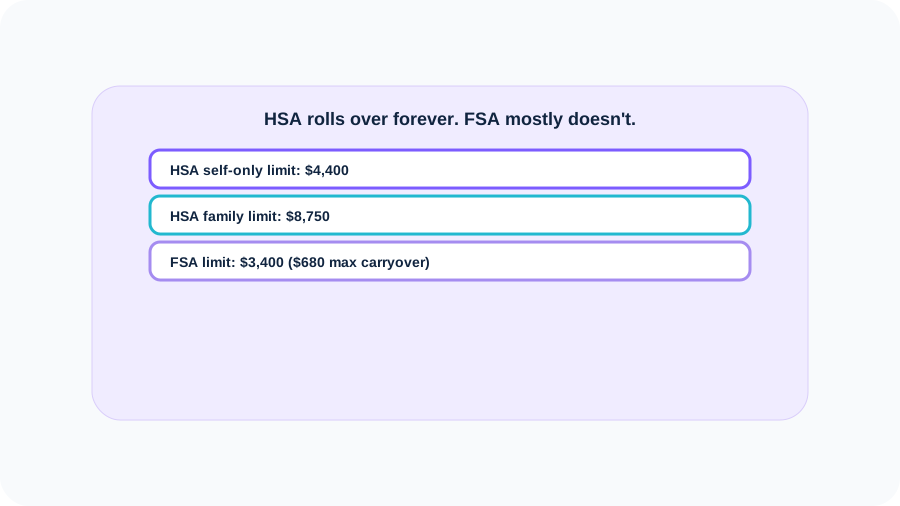
For 2026, the IRS HSA limit is $4,400 for self-only coverage and $8,750 for family coverage, per IRS Publication 969, with an additional $1,000 catch-up contribution allowed for account holders age 55 and older. The FSA limit for a healthcare FSA is $3,400 for 2026, per IRS Revenue Procedure 2025-32 — roughly 39% of the HSA family limit.
What Happens to Unused Money
This is the part that actually changes behavior. HSA balances roll over indefinitely, year after year, with no deadline to spend them — many HSAs can even be invested once the balance crosses a threshold, functioning like a second retirement account for medical costs. FSA balances generally must be used within the plan year, though many employers allow a limited carryover: for 2026, up to $680 can carry into 2027, with anything above that forfeited back to the employer.
Worked example: someone fully funds a $3,400 FSA for the year and spends $2,600 on eligible expenses, leaving $800 unspent. Only $680 of that can carry over under the maximum allowed carryover; the remaining $120 is forfeited. The same $800 sitting in an HSA instead would simply carry into next year in full, no forfeiture at all.
Step-by-Step: Deciding Which One Fits You
First, check whether your health plan qualifies as an HDHP — if it doesn't, an HSA isn't available to you regardless of preference, and the FSA is the only pre-tax option. Second, if both are available, estimate next year's predictable medical costs (known prescriptions, planned procedures, glasses/contacts) as a floor for FSA funding, since that money needs to be spent within the year. Third, for costs beyond that predictable floor, favor the HSA if eligible, since unused contributions simply carry forward rather than risking forfeiture.
Some employers offer a "limited-purpose FSA" (dental and vision only) designed to be paired with an HSA — if that option exists, it lets you capture pre-tax dental/vision spending without touching HSA eligibility.
What Happens If Your Situation Changes Mid-Year
An HSA moves with you: leaving a job, switching to a non-HDHP plan, or retiring doesn't affect the balance already in the account — it simply stops accepting new contributions until you're HDHP-eligible again, and the existing money remains yours, investable and spendable on qualified expenses indefinitely. An FSA is different: it's generally tied to the employer's plan year and to active employment, so leaving a job partway through the year usually forfeits any unspent FSA balance beyond what's already been reimbursed, unless COBRA continuation is elected for that specific benefit.
A common mid-year event worth planning around is a new HDHP enrollment partway through the year: HSA eligibility (and the contribution limit) is generally prorated based on the number of months of HDHP coverage, so contributing the full annual limit in a partial-eligibility year can create an excess contribution that needs to be corrected before the tax deadline. Checking the exact proration with a plan administrator before maxing out a partial-year HSA avoids this.
The Short Version
For 2026: HSA is $4,400 self-only / $8,750 family, requires an HDHP, and rolls over forever. FSA is $3,400, doesn't require an HDHP, and is mostly use-it-or-lose-it beyond a $680 carryover. If you're eligible for an HSA, it's generally the better long-term choice; the FSA still makes sense for predictable, employer-independent short-term costs or when an HDHP isn't an option. Either way, a job change or health plan change mid-year is worth double-checking against your specific contribution before assuming last year's rules still apply.
Product recommendation
Recommended DaveWays Resources
HSA/FSA Contribution & Spend Tracker
Tracks contributions against the 2026 limits and flags FSA balances at risk of forfeiture before the deadline.
Paycheck Budget Planner (US)
Fits pre-tax HSA or FSA elections into a full paycheck budget alongside your other deductions.
FAQ
What is the 2026 HSA contribution limit?
$4,400 for self-only coverage and $8,750 for family coverage, plus a $1,000 catch-up for age 55 and older, per IRS Publication 969.
What is the 2026 FSA contribution limit?
$3,400 for a healthcare FSA, per IRS Revenue Procedure 2025-32, with up to $680 allowed to carry over into 2027.
Can I have both an HSA and an FSA?
Generally only a limited-purpose FSA (dental and vision only) can be paired with an HSA; a general-purpose FSA usually disqualifies HSA eligibility.
Does unused HSA money expire?
No. HSA balances roll over indefinitely with no spending deadline and stay with you even if you change employers.
What happens to FSA money I don't spend?
Up to $680 can carry into the next plan year for 2026 balances; any amount above that is generally forfeited unless your employer offers a grace period instead.
Educational resource only, not tax or financial advice. Plan rules vary by employer; confirm your specific plan's carryover and grace-period policy with your benefits administrator. See IRS Publication 969 for official HSA and FSA guidance.
Join the email list for practical money worksheets, buying guides, and product updates.