Every fall, the IRS adjusts retirement account limits for inflation, and every January the new numbers quietly reset what "maxing out your 401(k)" actually means. For 2026, the standard employee limit went up by $1,000 from 2025. Most workers aren't contributing anywhere close to the limit — the more useful question isn't "can I hit $24,500," it's "what does raising my contribution by a few percentage points actually do to my paycheck and my retirement balance."
The 2026 Contribution Limits, in Full
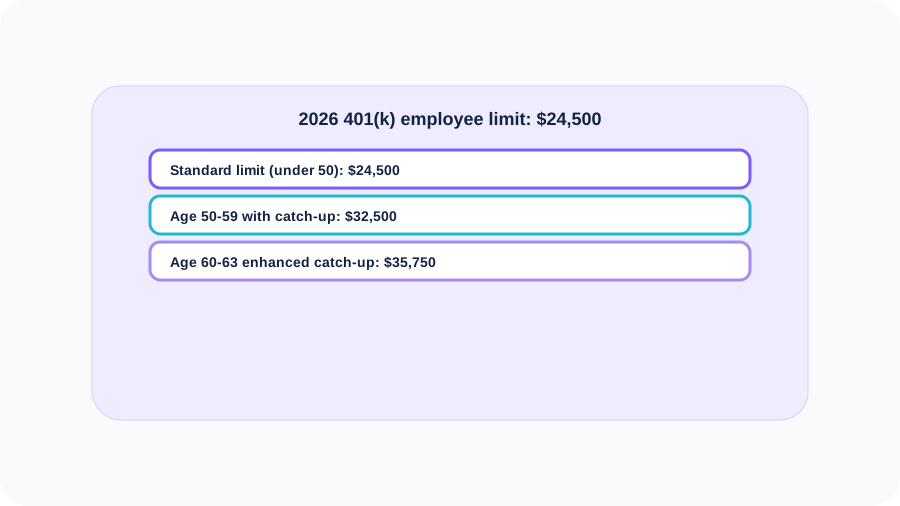
The IRS sets three separate numbers each year: the standard employee deferral limit, a catch-up limit for savers 50 and older, and (new since 2025) an enhanced catch-up for a narrow 60-to-63 age band. For 2026, per the IRS's official announcement, the standard limit is $24,500. Anyone turning 50 or older by December 31, 2026 can add an $8,000 catch-up, bringing their personal limit to $32,500. Savers who are age 60, 61, 62, or 63 specifically get a higher $11,250 catch-up instead of the standard $8,000, for a total of $35,750.
These limits apply to your own employee contributions — traditional pre-tax and Roth 401(k) contributions combined count toward the same cap. Employer matching and profit-sharing contributions are tracked separately and don't count against your personal limit, so an employer match is effectively free money on top of whatever you personally contribute.
How Much of the Limit Does a Typical Contribution Actually Use?
Take someone earning $65,000 a year. Contributing 10% of salary is $6,500 a year — about 27% of the 2026 limit. Raising that to 15% is $9,750 a year, still only 40% of the limit. Contributing the full $24,500 max would require setting aside nearly 38% of gross pay, which isn't realistic for most people at that income and isn't the point of this exercise — the limit is a ceiling, not a target.
What matters more day to day is the gap between what you're contributing now and what your employer will actually match, which is covered in the next section.
Step-by-Step: Setting or Raising Your Contribution Percentage
First, check your current contribution percentage in your payroll or plan-provider portal — not the dollar amount, the percentage, since that's what determines how it scales with future raises. Second, check your plan's matching formula, usually stated as something like "50% match on the first 6% you contribute." Third, calculate the paycheck impact of a change before making it: a traditional (pre-tax) contribution reduces your taxable income, so the hit to your take-home pay is smaller than the raw contribution amount.
Worked example: raising a contribution from 10% to 12% on a $65,000 salary adds $1,300 a year in contributions, or $50 per biweekly paycheck (26 pay periods) before tax effects. Assuming a 22% marginal federal tax bracket, the actual reduction in take-home pay is closer to $39 per paycheck, since the $50 pre-tax contribution lowers the income tax withheld on that paycheck by roughly $11.
Don't Leave the Employer Match Unclaimed
A common matching formula is 50% up to 6% of pay — meaning the employer adds 50 cents for every dollar an employee contributes, up to 6% of salary. On a $65,000 salary, contributing the full 6% ($3,900) captures a $1,950 employer match. Contributing only 3% ($1,950) captures just $975 in match — leaving $975 in employer money unclaimed for the year, every year it isn't corrected.
Before increasing a contribution past the match threshold toward the IRS limit, confirm the exact match formula with HR or the plan document, since formulas vary widely (some match per-paycheck and don't true up a shortfall at year-end if contributions front-load early in the year).
The Short Version
The 2026 401(k) employee limit is $24,500, $32,500 with the age-50 catch-up, and $35,750 for ages 60–63 — but the limit is rarely the binding constraint for most savers. The more useful numbers are your plan's match formula and the gap between your current contribution and the percentage needed to capture the full match, since that's effectively a guaranteed return that a later increase toward the IRS max can't replicate.
Product recommendation
Recommended DaveWays Resources
Retirement & 401(k) Contribution Tracker
Tracks your contribution percentage against the 2026 IRS limit and your employer's match formula in one sheet.
Paycheck Tax Withholding Checkup
Estimates how a pre-tax contribution change actually affects your take-home pay before you make it.
FAQ
What is the 401(k) contribution limit for 2026?
The employee contribution limit is $24,500 for 2026, up from $23,500 in 2025, per the IRS.
How much extra can I contribute if I'm 50 or older?
An $8,000 catch-up contribution, for a $32,500 total limit in 2026.
Is the catch-up limit different for ages 60 to 63?
Yes. Ages 60, 61, 62, and 63 get an enhanced $11,250 catch-up instead of $8,000, for a $35,750 total limit in 2026.
Does my employer's match count toward my personal limit?
No. The employee limits above apply only to what you personally contribute. Employer matching and profit-sharing are tracked under a separate, higher combined limit.
What happens if I accidentally contribute more than the limit?
Contact your plan administrator as soon as possible; excess contributions generally need to be withdrawn (with any earnings) before the tax filing deadline to avoid double taxation.
Educational resource only, not financial or tax advice. The examples above are illustrative; your own salary, tax bracket, and plan rules will differ. See the IRS's official 2026 401(k) limit announcement for current figures.
Join the email list for practical money worksheets, buying guides, and product updates.