
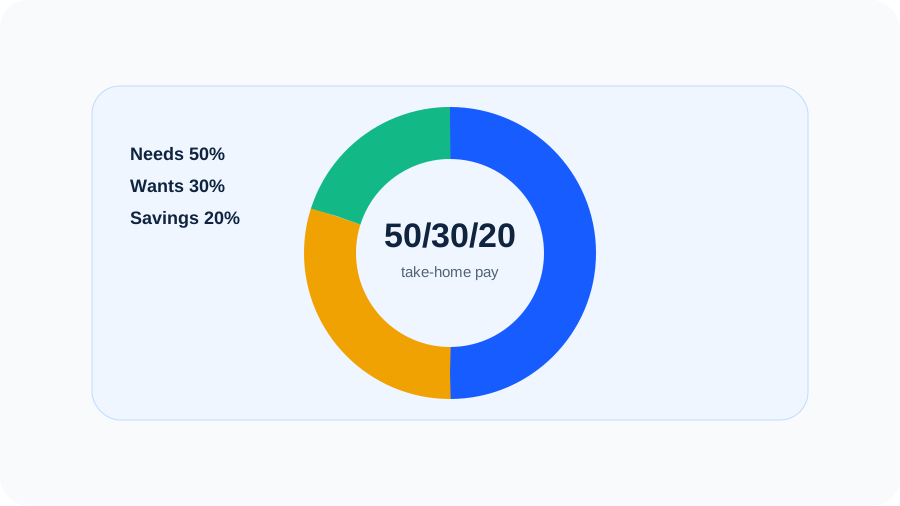
The rule splits your take-home pay three ways: 50% to needs, 30% to wants, 20% to savings and extra debt payments. It's a genuinely useful starting point — the trouble starts when people treat the percentages as fixed rather than as a diagnostic for where their money is actually going.
What Actually Counts As A Need
This is where most budgets quietly fail. A need is something you'd keep paying if your income dropped tomorrow: housing, utilities, groceries, insurance, transport to work, and minimum debt payments. Streaming subscriptions, dining out, and a bigger apartment than you strictly require are wants, even if they feel essential day to day.
Being honest about this split matters more than the exact percentages, because misclassifying wants as needs is how the 50% bucket quietly swells to 65% without anyone noticing.
Why It Breaks In High-Rent Cities
If rent alone takes 45–55% of your income, the standard split simply doesn't fit — and that's a housing-cost problem, not a discipline problem. Forcing the framework in that situation just produces a budget you fail every month through no fault of your own.
The fix isn't to abandon the framework, it's to adjust it. A 60/20/20 split acknowledges the real cost of housing while still protecting a savings bucket, however small. The important number to protect is the third bucket staying above zero, not the first bucket matching an arbitrary 50%.
Irregular Income Doesn't Divide Cleanly
Freelancers, commission earners, and shift workers don't have a single stable “take-home pay” figure. Applying fixed percentages to a number that swings significantly month to month produces a budget that's technically wrong most months.
The more useful approach is to apply the percentages to your lowest typical month, treating anything earned above that baseline as a windfall to route toward savings or debt. This keeps the framework honest without requiring a stable paycheque.
Four Adjusted Splits That Actually Work
The percentages are a starting point, not scripture. Pick the variant that matches your situation.
- Standard (50/30/20). Moderate cost of living, stable income.
- High-rent (60/20/20). Expensive metros where housing is fixed short-term.
- Getting started (70/20/10). Early career or a tight margin — protects the habit of saving something over hitting a target percentage.
- Debt sprint (50/15/35). A time-boxed six-to-twelve-month aggressive payoff period.
Whatever split you choose, the third bucket should never be zero. Even 3% builds the habit and the account, and a habit at 3% can be raised later — a habit at 0% has to be created from nothing.
Product recommendation
Recommended DaveWays Resources
Budget Blueprint
A monthly budget system for planning income, bills, flexible spending, and savings.
All-in-One Budget Spreadsheet
Plan a full year and any single month in one connected workbook.
Making It Run Itself
Calculate your three numbers once, based on your chosen split, and automate the savings bucket first — transferring it the day after payday. Paying yourself first is the entire mechanism; the other two buckets then compete for what's left, rather than savings getting whatever happens to remain.
Review the three totals monthly, not daily. Daily tracking is a common cause of budget abandonment, and the framework is designed to be checked in, not micromanaged.
When To Use Something Else
Use zero-based budgeting if you want tighter control and don't mind the admin, since every dollar gets a job before the month starts. Use a pay-yourself-first system if percentages irritate you — automate savings, then spend the rest freely. Use envelopes if overspending in specific categories is your actual problem, since they create a hard stop that percentages don't.
FAQ
What is the 50/30/20 budget rule?
It splits take-home pay into 50% needs, 30% wants, and 20% savings plus extra debt payments.
Is it based on gross or net income?
Net - take-home pay after tax. Work from what actually lands in your account.
What if my rent is more than 50% of my income?
Use an adjusted split like 60/20/20 and keep the savings bucket non-zero however small.
Does the 20% include debt payments?
Minimum payments are needs and belong in the 50%. Extra payments belong in the 20%.
How do I use it with irregular income?
Apply the percentages to your lowest typical month and treat anything above that as a windfall.
Educational resource only. Not financial, tax, legal, or credit advice.