
"I was busy all day but got nothing done" is usually a task-switching problem, not an effort problem. Deep work is the practice of protecting blocks of time where switching simply isn't possible — not through willpower, but through removing the option.
Why Interruptions Cost More Than They Seem
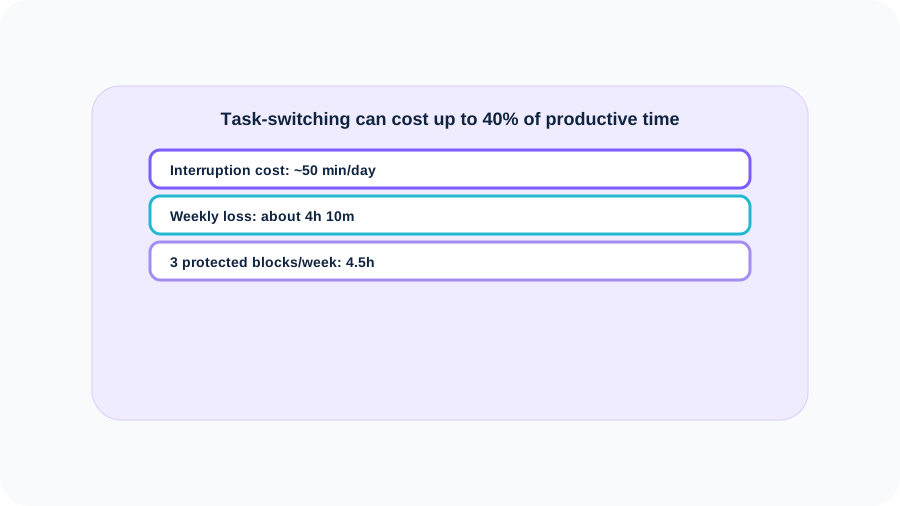
Cognitive psychologist David Meyer's research, cited by the American Psychological Association, found that even brief mental blocks created by shifting between tasks can cost as much as 40% of someone's productive time. The individual cost of one switch feels tiny — a few seconds to reorient — but that cost compounds every time attention moves between an in-progress task and a new one, which is what makes a day full of small interruptions feel unproductive even when it was full of activity.
How Much Focus Time Are You Actually Losing?
Take a conservative, illustrative estimate: 5 unplanned interruptions in a workday (a notification, a quick question, checking a message), each costing about 10 minutes to fully refocus on the original task — a deliberately conservative number, well below the roughly 23 minutes some interruption-recovery research has found. That's 50 minutes a day, or just over 4 hours across a 5-day week, spent recovering from interruptions rather than doing the work itself.
Step-by-Step: Building a 90-Minute Deep Work Block
Pick the single task the day before, not the morning of — deciding what to work on is itself a task-switch if done at the start of the block. Block the calendar for the full 90 minutes and treat it as an unmovable meeting. Put the phone in another room, not just on silent, since visibility alone creates a pull toward checking it. Close every browser tab and application except the one needed for the task. Set a visible 90-minute timer, work on the single task only, and use a 10-minute shutdown ritual at the end — note what's unfinished and what the next step is, so the next session doesn't start with re-orientation time.
Scaling It: 3 Blocks a Week
Three 90-minute blocks a week is 4.5 hours — comparable to the roughly 4 hours 10 minutes lost to interruption recovery in the earlier example, but concentrated into focused output instead of scattered recovery time. Over a month, 3 blocks a week is about 18 hours of protected, single-task work, which is often enough to move a genuinely stalled project (a report, a business plan, a course) from stuck to finished in a way that the same 18 hours spread across constantly-interrupted days would not.
What to Do About Genuinely Urgent Interruptions
Not every interruption is optional, and a deep work system that can't accommodate a real emergency gets abandoned the first time one happens. The fix isn't leaving the block fully open to anything — it's defining, before the block starts, exactly what qualifies as urgent enough to break it (a small, named list: a specific person, a specific type of event) versus what can wait 90 minutes, which is nearly everything else.
For anyone whose role genuinely requires fast response to unpredictable events, a narrower block still works: even a 25-to-45-minute version, with the same phone-away, single-task rules, still interrupts the task-switching cycle meaningfully more than no protected time at all. The length matters less than the rule that nothing outside the pre-defined urgent list gets in.
The Short Version
Task-switching can cost up to 40% of productive time. A 90-minute block with the phone in another room, one task only, and a 10-minute shutdown ritual is enough to protect real focus time from that cost. Three blocks a week adds up to 18 hours of protected work a month — usually enough to finish what constant interruption has kept stuck. Defining a short, specific list of genuine exceptions in advance keeps the system realistic enough to actually stick with.
Product recommendation
Recommended DaveWays Resources
Deep Work & Focus Session Tracker
Logs protected focus blocks against a weekly target, built around the same 90-minute block structure.
Time-Blocking Planner
Schedules deep work blocks into a full week alongside meetings and shallow work, so they don't quietly disappear.
FAQ
What is deep work?
A period of focused, distraction-free effort on a single cognitively demanding task, as opposed to shallow, easily-interrupted work.
How much productivity does task-switching actually cost?
Research cited by the American Psychological Association found that task-switching can cost as much as 40% of someone's productive time.
How long should a deep work block be?
90 minutes is a practical starting length — long enough for real progress, short enough to sustain without burning out.
Why put the phone in another room instead of just on silent?
Visibility alone creates a pull toward checking it, even on silent; removing it from the room removes the option entirely.
How many deep work blocks a week is realistic?
3 blocks a week (4.5 hours) is a sustainable starting target for most schedules, and can be increased once the habit is established.
Educational resource only. The interruption-cost figures above are an illustrative, conservative example; actual recovery time varies by person and task. See the American Psychological Association's research on multitasking and task-switching for further reading.
Join the email list for practical productivity worksheets, buying guides, and product updates.