
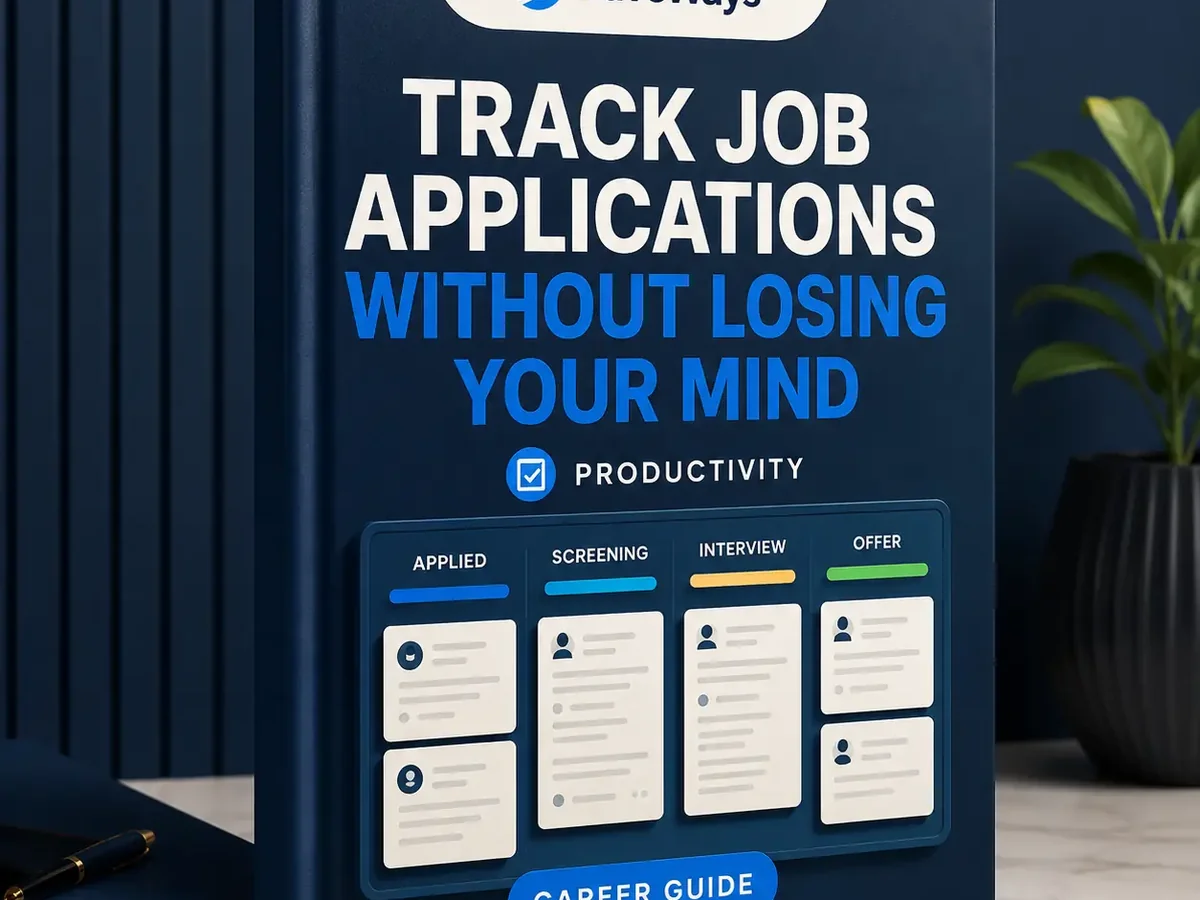
Why Scattered Tracking Fails
Ask most people how many jobs they've applied to and you'll get a rough number back — "probably 30, maybe 40." Ask them their actual response rate, or what share of interviews turn into offers, and you'll usually get a shrug instead. Not because they don't care, but because those numbers simply don't exist yet. They're scattered across a dozen email threads, three job-board dashboards, and whatever's still rattling around in memory — and none of that adds up to anything useful until it's sitting in one place.
A Worked One-Month Example
Here's how one month actually played out. 40 applications went out. 7 came back with some kind of response — a few rejections, a request for more information, a couple of interview invites. Of those 7, 4 turned into actual interviews. And of those 4 interviews, 1 turned into an offer.
Laid out as a funnel like that, the drop-off at each stage becomes visible for what might be the first time. That's genuinely hard to see from memory once the count passes a handful of applications — nobody's mental math is tracking exactly which of the last 40 emails got a reply, let alone turning that into a percentage.
Turning the Funnel Into Conversion Rates
Turn those same numbers into rates and they start to actually mean something. 7 responses out of 40 applications works out to a 17.5% response rate. 4 interviews out of 7 responses is a 57.1% response-to-interview rate — a genuinely strong number once someone does respond. And 1 offer out of 4 interviews lands at a 25% interview-to-offer rate.
This stage-by-stage breakdown matters a lot more than the raw application count, because it points at exactly where the funnel is weak, or isn't. A low response rate usually points back at the applications themselves, the resume, or how well the role actually matches what's being applied for. A strong response rate paired with weak interview conversion points somewhere else entirely — something happening in the interview room, not on paper. Those are two completely different problems to fix, and they look identical if the only thing being tracked is "I've applied to 40 jobs."
Step-by-Step: Building the Tracker
Log every application the same day you send it — company, role, date applied, and where you found the listing — before moving on to the next one. It's tempting to batch this later, "I'll log everything Friday," but that's exactly how gaps creep in; by Friday you won't remember which resume version went where.
Set a specific follow-up date for each one, not a vague "I'll follow up eventually." Seven to ten days after applying, if you haven't heard anything, is the common rule of thumb, and having an actual date on the calendar means you'll actually do it instead of letting it slide indefinitely.
Update the status the moment anything changes — a response comes in, an interview gets scheduled, a rejection lands, an offer shows up. Keeping this current is what makes the tracker something you can trust; one that's three weeks out of date is barely better than not having one at all.
Every so often, calculate your own conversion rates — response rate, response-to-interview rate, interview-to-offer rate — and look at which stage is actually weak. It's easy to assume the fix is "just apply to more jobs," but the numbers might say something different: maybe the applications are working fine and the interviews are where things fall apart, or the other way around.
And before sending the next batch, take a few minutes to look back at what got rejected or ignored, and see if there's a pattern — same resume version, same type of role, same industry — worth adjusting before repeating it forty more times.
What the Numbers Don't Tell You
One honest caveat about numbers like these: 40 applications is a small enough sample that a single extra response or one more interview can swing the percentages a lot. Going from 7 responses to 8 moves the response rate from 17.5% to 20% — a jump that looks meaningful on a chart but might just be one recruiter having a good week. Treat early numbers as a rough compass, not a verdict on how the search is going, and give the tracker at least a couple of months of data before drawing hard conclusions from it.
It also helps to remember that response and interview rates move with things that have nothing to do with the applications themselves — the season, the specific industry, how many other people are hiring or job-hunting at the same time, even the state of the broader economy. A 17.5% response rate might be completely normal in one field and unusually strong in another. Comparing your numbers against your own history, month over month, tells you a lot more than comparing them to a number you saw somewhere online.
The Short Version
If you take just one thing from this, make it this: track every application's status, date, and follow-up date in one place, and calculate stage-by-stage conversion rates instead of just counting how many applications went out. Here, that's a 17.5% response rate, a 57.1% response-to-interview rate, and a 25% interview-to-offer rate — numbers that point straight at which stage of the search actually needs the attention, instead of leaving you to guess.
Product recommendation
Recommended DaveWays Resources
Job Search Application Tracker
Automatically flags applications needing follow-up after 10 days of silence, instead of losing track across email and job boards.
Resume & Interview Prep Organizer
Build a tailored STAR-format answer bank for each company you interview with, instead of reusing the same generic talking points everywhere.
FAQ
What should a job application tracker include, at minimum?
At minimum, log the company, the role, the date you applied, where you found the listing, the current status, and a specific date for your next follow-up. That's a small enough list to keep up with consistently, and it's enough to answer almost any question you'd want to ask about how the search is actually going.
How soon should I follow up after applying with no response?
Seven to ten days is the common rule of thumb if you haven't heard anything back. Much sooner than that can come across as impatient, and waiting a lot longer just means a follow-up email showing up after the role may already be filled.
What's a realistic response rate to expect?
It varies a lot by industry, role, and market conditions, so there's no single number that applies to everyone. This worked example landed at a 17.5% response rate from 40 applications, which is more useful as an illustration of how to calculate your own rate than as a benchmark to compare yourself against.
How do I know which stage of my job search needs the most attention?
Calculate your own stage-by-stage conversion rates — response rate, interview rate, offer rate, the same way this example works out to 17.5% / 57.1% / 25% — and look at which one is noticeably weaker than the others. That's usually a more useful signal than a general feeling that the search isn't going well.
Should I keep applying to similar roles after repeated rejections?
Before sending more of the same, check for a pattern first — is it the same resume version, the same type of role, or the same industry showing up across the rejections? If there's a clear pattern, adjusting before the next batch usually beats sending forty more applications unchanged and hoping for a different result.
Illustrative example only — actual response and interview rates vary widely by industry, role level, and local job market conditions. See CareerOneStop, sponsored by the U.S. Department of Labor, for official job-search tracking guidance.
Join the email list for practical productivity worksheets, planning guides, and product updates.