
"How many do I need to sell to stop losing money" is one of the few business questions with an exact, calculable answer. Break-even analysis isn't a rough estimate — it's arithmetic, and getting the three inputs right matters more than the formula itself.
The Formula, Explained
Break-even point in units = Fixed Costs ÷ (Price − Variable Cost per Unit). Fixed costs are expenses that don't change with how much is sold — rent, software subscriptions, salaried staff. Variable cost per unit is what it costs to produce or deliver one more unit — materials, a per-order processing fee, hourly contractor time tied directly to that unit. Price minus variable cost is the contribution margin: how much of each sale is left over to pay down fixed costs before any profit begins. The U.S. Small Business Administration's break-even calculator uses this same formula as its foundation for business planning.
Worked Example: A Solo Service Business
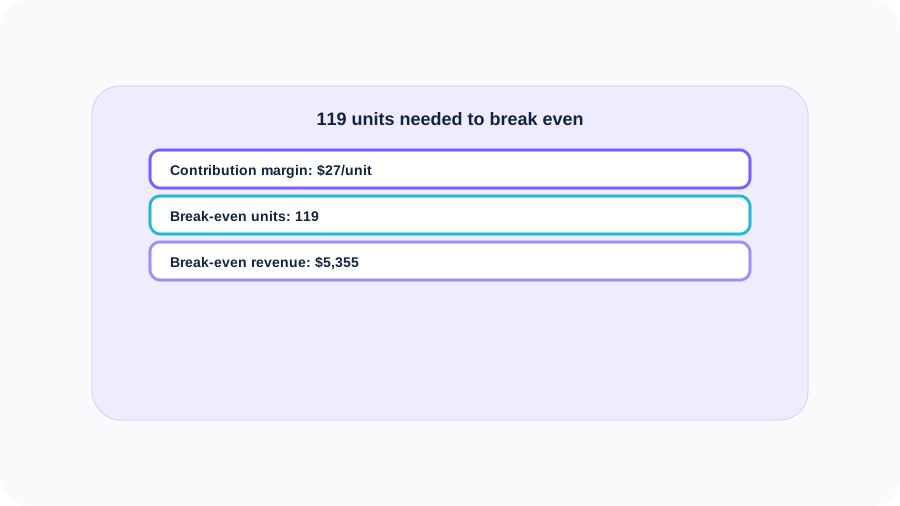
A solo business has $3,200 a month in fixed costs (software, a coworking desk, insurance). It sells a service package at $45, with $18 in variable cost per package (contractor time, materials, payment processing). The contribution margin is $45 − $18 = $27 per unit. Break-even units = $3,200 ÷ $27 = 118.5, rounded up to 119 units, since a partial unit doesn't fully cover costs. At $45 each, that's $5,355 in monthly revenue just to reach zero profit — the 120th unit and beyond is where the business actually makes money.
Step-by-Step: Calculating Your Own Break-Even Point
List every fixed cost that continues regardless of sales volume for one month, and total it. List the true variable cost of delivering exactly one unit — be specific, since underestimating this is the most common error and makes the break-even point look lower than it really is. Subtract variable cost from price to get the contribution margin. Divide total fixed costs by the contribution margin, and round up to the next whole unit.
What Changes the Break-Even Point
Raising the price is usually the fastest lever. In the same example, raising price from $45 to $50 (variable cost unchanged at $18) increases the contribution margin to $32. New break-even units = $3,200 ÷ $32 = 100 units — 19 fewer units needed to cover the same fixed costs, without any change to how the business operates.
Using Break-Even to Evaluate a New Fixed Cost
Break-even analysis is also a decision tool for a new expense, not just a snapshot of the current business. Take the same $3,200-fixed-cost, $27-contribution-margin business considering a $500-a-month part-time assistant. New fixed costs become $3,700; new break-even units = $3,700 ÷ $27 = 137.04, rounded up to 138 — 19 more units a month than the current 119, before the hire even becomes worth it in dollar terms.
Framed that way, the real question isn't "can I afford $500 a month" but "will this hire reliably help sell 19 more units a month" — a much more concrete test than a gut-feel budget decision, and one that applies to any new recurring cost: software, advertising, a subscription tool, or additional space.
The Short Version
Break-even units = Fixed Costs ÷ (Price − Variable Cost). In the worked example, $3,200 in fixed costs and a $27 contribution margin means 119 units, or $5,355 in revenue, before any profit begins. The two levers that move this number are lowering fixed costs and raising the contribution margin — through price, lower variable cost, or both — and the same formula works in reverse, as a concrete test for whether a new recurring cost is actually worth adding.
Product recommendation
Recommended DaveWays Resources
Break-Even & Pricing Calculator
Runs this exact formula against your real fixed costs, price, and variable costs to find your own break-even point.
12-Month Cash Flow Forecast Planner (US)
Projects when break-even is actually reached month by month, not just as a static target.
FAQ
What is the break-even point formula?
Break-even units = Fixed Costs ÷ (Price − Variable Cost per Unit). Multiply by price to get break-even revenue.
What counts as a fixed cost?
Expenses that don't change with sales volume, like rent, software subscriptions, insurance, and salaried staff pay.
What counts as a variable cost?
The cost to produce or deliver exactly one more unit — materials, per-order fees, or hourly contractor time tied directly to that unit.
Why round the break-even units up?
A partial unit doesn't fully cover fixed costs, so 118.5 units means the business hasn't actually broken even until the 119th unit sells.
What's the fastest way to lower my break-even point?
Raising price usually has the biggest effect for the least operational change, since it increases the contribution margin on every unit without touching costs.
Educational resource only, not financial or business advice. The figures above are an illustrative example; your own costs, pricing, and margins will differ. See the U.S. Small Business Administration's break-even point calculator for further reading.
Join the email list for practical business worksheets, buying guides, and product updates.