
"How much does it cost to start a business" gets answered with one big scary number more often than it should, and that number is usually an average across business types that have almost nothing in common with each other. A storefront and a solo consulting side business are not the same math problem.
Why "Average Cost" Isn't a Useful Number for You
A 2026 survey of small business owners by Business.org found an average first-year spend of about $40,000 across all business types — but broken down by model, online-only businesses averaged $35,000, mobile businesses $92,500, and storefront businesses $100,000. A single blended average obscures a huge range: most small businesses in the U.S. spend somewhere between $3,000 and $200,000-plus to get started, depending heavily on whether the business needs a physical location, inventory, or employees on day one.
A Real Lean Startup Budget: Line by Line
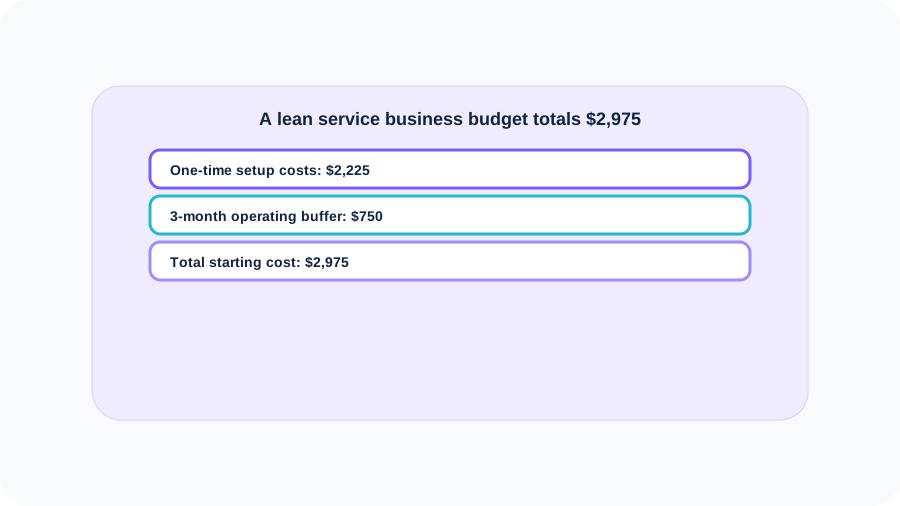
For a solo, service-based side business with no physical storefront and no employees, one-time setup costs realistically look like: LLC formation filing fee $150, business license $75, a basic logo and one-page website $600, a laptop or equipment upgrade $900, and initial supplies $500 — a $2,225 one-time total. Add ongoing monthly costs of software subscriptions $45, business insurance $40, website hosting $15, and a modest marketing budget $150, for $250 a month. A 3-month operating buffer at that rate is $750. Total realistic starting cost: $2,225 + $750 = $2,975.
Step-by-Step: Building Your Own Startup Budget
The SBA's guidance on estimating starting costs breaks the total into three parts: expenses incurred before the business opens (legal fees, early marketing, signage), assets the business needs on day one that aren't cash (equipment, inventory, a vehicle), and cash reserved to cover operating deficits while the business is still building revenue. List all three separately using real quotes and prices, not rough guesses, then add them together for the total starting cost figure.
Where the Money Actually Goes First
Legal formation and licensing should come before any spending on marketing or equipment, since operating without the right business structure or license can create bigger costs later. After that, the operating buffer matters more than any single piece of equipment — a business with $2,225 in setup but zero operating cushion is more fragile than one with a smaller setup budget and a real 3-month buffer, since the buffer is what survives an inevitable slow first month or two.
If the $2,975 Still Isn't Sitting in Savings
Not everyone starting a lean side business has $2,975 in savings to deploy at once, and that's a financing question, not a reason to abandon the budget. The SBA's Microloan Program provides loans up to $50,000 to help small businesses start or expand, with an average loan size of about $13,000 — well above what a $2,975 lean budget needs, meaning a much smaller loan request within that program is realistic for exactly this kind of startup cost.
Whatever the funding source — personal savings, a microloan, or a 0% introductory-rate business card used deliberately and paid off before the rate resets — the same $2,225-plus-$750 line-item budget from the section above is what determines how much actually needs to be borrowed, rather than borrowing a round number that either falls short mid-launch or sits partly unused as expensive idle debt.
The Short Version
Generic "average cost to start a business" figures near $40,000 mostly reflect storefront and mobile businesses, not lean service-based ones. A line-item budget for a solo service business — $2,225 in one-time setup plus a $750 three-month buffer, for $2,975 total — is a far more realistic starting number for that kind of business, and worth building as your own itemized list rather than borrowing a national average that doesn't match your model. If that amount isn't available in savings, size any financing to the actual line-item total, not to a round guess.
Product recommendation
Recommended DaveWays Resources
Business Launch Checklist & Startup Cost Tracker (US)
Itemizes one-time and monthly startup costs the same way as the worked example above, for your own numbers.
LLC Formation & Compliance Checklist
Covers the legal formation step that belongs first in the spending order described above.
FAQ
How much does it cost to start a small business on average?
National surveys cite roughly $40,000 for the first year on average, but this varies enormously by business model — from about $35,000 for online-only businesses to $100,000 for storefronts.
Can I really start a business for under $3,000?
A lean, service-based side business with no storefront, inventory, or employees can realistically launch in the $3,000 range, as shown in the $2,975 line-item example above.
What are the three categories of startup costs, per the SBA?
Pre-opening expenses, non-cash assets needed on day one, and cash reserved to cover early operating deficits.
How much of a buffer should I budget beyond one-time setup costs?
A 3-month operating buffer at your expected monthly costs is a reasonable starting point, so a slow first quarter doesn't immediately threaten the business.
What should I budget for first?
Legal formation and licensing before marketing or equipment, since operating without the correct structure or license can create larger costs later.
Educational resource only, not legal or financial advice. Costs above are an illustrative example for one type of business; your own filing fees, licensing requirements, and costs will vary by state and industry. See the U.S. Small Business Administration's guide to estimating starting costs for official guidance.
Join the email list for practical business worksheets, buying guides, and product updates.