There is no universal Google Ads budget for a small business, and any number quoted without knowing your industry is a guess. The honest answer is that your starting budget is decided by one thing: how much a conversion costs you, and how many conversions you need before the numbers mean anything. Work backwards from those two figures and the budget calculates itself.
For many small businesses that lands somewhere between $1,000 and $3,000 a month. But the number matters far less than the reasoning, because the same $1,000 can be a sensible test in one industry and a guaranteed waste in another.
The Only Formula You Actually Need
Three inputs, one output:
(target cost per conversion x conversions needed per month) / 30 = daily budget
Target cost per conversion is what you can afford to pay for a lead or a sale. If a customer is worth $600 in profit and one in four leads becomes a customer, a lead is worth up to $150 to you. Set your target below that.
Conversions needed per month is not only what you want. It is what the campaign needs before you can read the data with any confidence. Google's Target CPA help says performance evaluation is more accurate over periods with at least 30 conversions, and Google Keyword Planner is the right place to estimate keyword costs before launch.
Worked example. A local service business with a $100 target cost per lead, needing 20 leads a month:
$100 x 20 / 30 = $67 per day, or about $2,000 a month.
If that number is uncomfortable, the answer is not to halve the budget. It is to halve the targeting: fewer keywords, tighter geography, and a smaller campaign that can still collect usable data.
What A Click Actually Costs
Your cost per conversion depends on cost per click and conversion rate, and CPC varies enormously by sector. Published benchmark reports are useful for orientation, but they are vendor samples, not your auction. Averages also hide the range that matters most to you: a national average says very little about what an emergency plumber, immigration lawyer, or niche consultant pays in one specific city.
The more useful metric is cost per lead, because it accounts for whether your landing page converts. A $3 click that converts at 1% costs $300 a lead. An $8 click that converts at 8% costs $100. The cheaper click is the more expensive customer.
Why Spending Too Little Wastes More
A small budget feels cautious. In Google Ads it can be the riskier option, because it produces too little evidence to optimize against.
Automated bidding uses conversion signals to decide which auctions are worth entering. A campaign that produces four conversions a month never gives the system much to learn from, and it gives you even less. With four conversions you cannot tell a good week from a lucky one. You will pause a keyword that was working and scale one that was not, because at that volume normal variance looks exactly like signal.
The practical consequence: $500 per month spread across thirty keywords in a competitive sector will usually return nothing usable. The same $500 aimed at four keywords in one city might. If your viable budget is genuinely small, spend it narrowly rather than thinly.
What Different Budgets Can Realistically Buy
Assuming a 5% landing page conversion rate, which is an illustrative mid-range figure for a decent page:
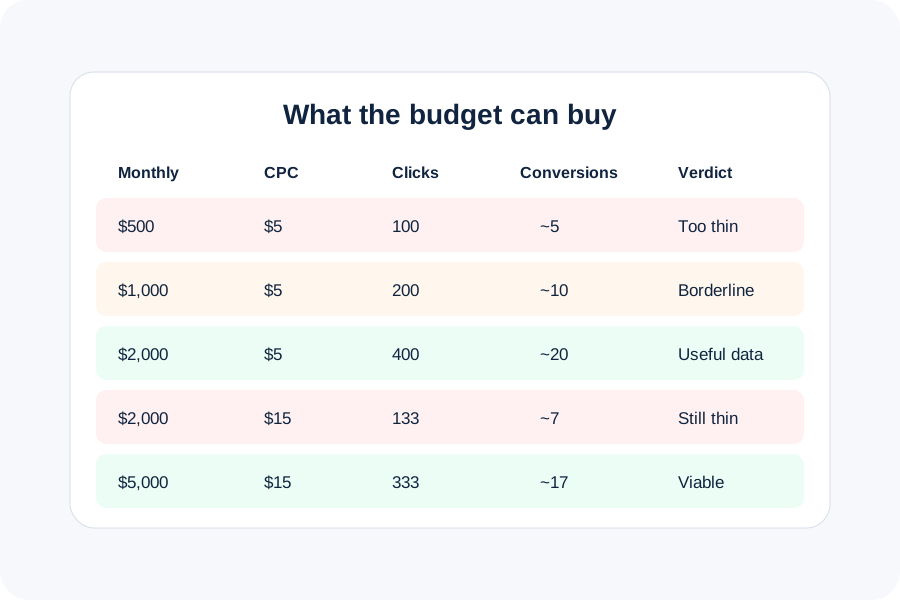
Read across, not down. The budget is not the variable that decides viability. The CPC in your sector is.
How Long Before You Can Judge It
Budget and time are the same question. Money spent over too short a window teaches you nothing.
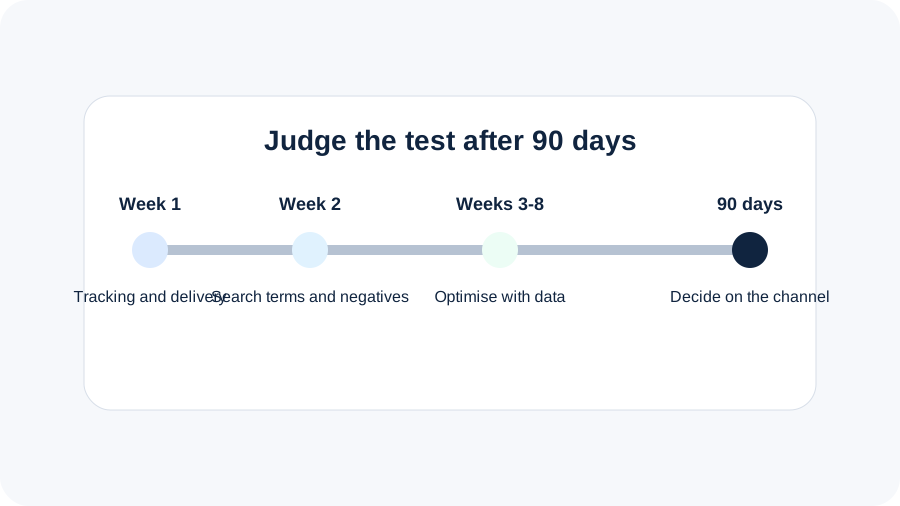
Anyone who says Google Ads did not work after two weeks and $300 has measured almost nothing. That is a normal early test window on a starved budget.
Budget for a 90-day test and commit the full amount before you start. A campaign switched off in week three costs you the spend and returns little information, which is usually the worst outcome.
What To Do When The Maths Does Not Work
Sometimes you run the formula and the answer is more than the business can spend. That is a real result, not a failure.
Shrink the target. One city instead of a region. One service instead of five. A $2,000 budget on one high-intent service beats $2,000 spread across the whole catalog.
Fix conversion rate before adding budget. Doubling a landing page's conversion rate halves cost per lead. That is free budget, and usually easier than finding cheaper clicks.
Raise what a conversion is worth. If you can lift close rate or average order value, you can afford a higher CPC than competitors with weaker economics.
Use a cheaper channel first. If your realistic budget is $300 per month in a $15-CPC sector, Google Ads is probably not the right first channel. Search-optimized content, local listings, or email may do more with that money.
For some small businesses, the right starting budget for Google Ads is zero until something else in the funnel is working.
Deciding It On Paper First
Every figure above should be written down before you open the ads interface: target cost per conversion, close rate, conversions needed, and the 90-day commitment. Inside the interface the easiest thing on the screen is always the Continue button.
The Google Ads Launch Kit is the worksheet version of this: campaign planning sheets, a pre-launch checklist, and tracking templates for the first 30 days. One-time $29.99, delivered digitally. It will not tell you your industry's CPC, because only Keyword Planner and your own campaign data can do that, but it stops you launching without deciding what a lead is worth.
If the harder question is whether the business can carry a 90-day ad test at all, that is a cash-flow question rather than a marketing one, and the Monthly Money Dashboard is built for it.
Product recommendation
Recommended DaveWays Resources
Google Ads Launch Kit
Campaign planning sheets, launch checklists, and tracking templates for search ads.
Monthly Money Dashboard
A dashboard-style money tracker for monthly cash flow, bills, debt, and savings.
FAQ
What is the minimum realistic Google Ads budget for a small business?
Enough to produce roughly 15-30 conversions a month, or at least enough to evaluate performance over a period with meaningful conversion volume. In a low-cost sector that can be under $1,000 per month. In legal or insurance it is often several thousand. Calculate it from your own cost per conversion rather than picking a round number.
Is $500 a month enough for Google Ads?
Usually only if your cost per click is low and you aim it very narrowly: one city and a handful of high-intent keywords. Spread across broad targeting, $500 produces too few conversions to optimize against.
How long should I run Google Ads before deciding if it works?
Budget for a 90-day test. Avoid major structural changes in the first two weeks unless tracking is broken or the campaign is serving irrelevant searches.
Should I set a daily budget or a monthly one?
Google Ads runs on daily budgets and may spend more on individual days while staying within billing limits. Set the daily figure from the formula above, then check monthly pacing weekly.
Educational content, not financial advice. DaveWays is not affiliated with or endorsed by Google. Advertising costs and platform settings change frequently. Confirm current figures in Google Keyword Planner and Google Ads Help before committing budget.
Sources to check before launch: Google Ads Help on Target CPA bidding and Google Ads Help on Keyword Planner.
Get New DaveWays Guides
Join the email list for practical marketing worksheets, buying guides, and product updates.