
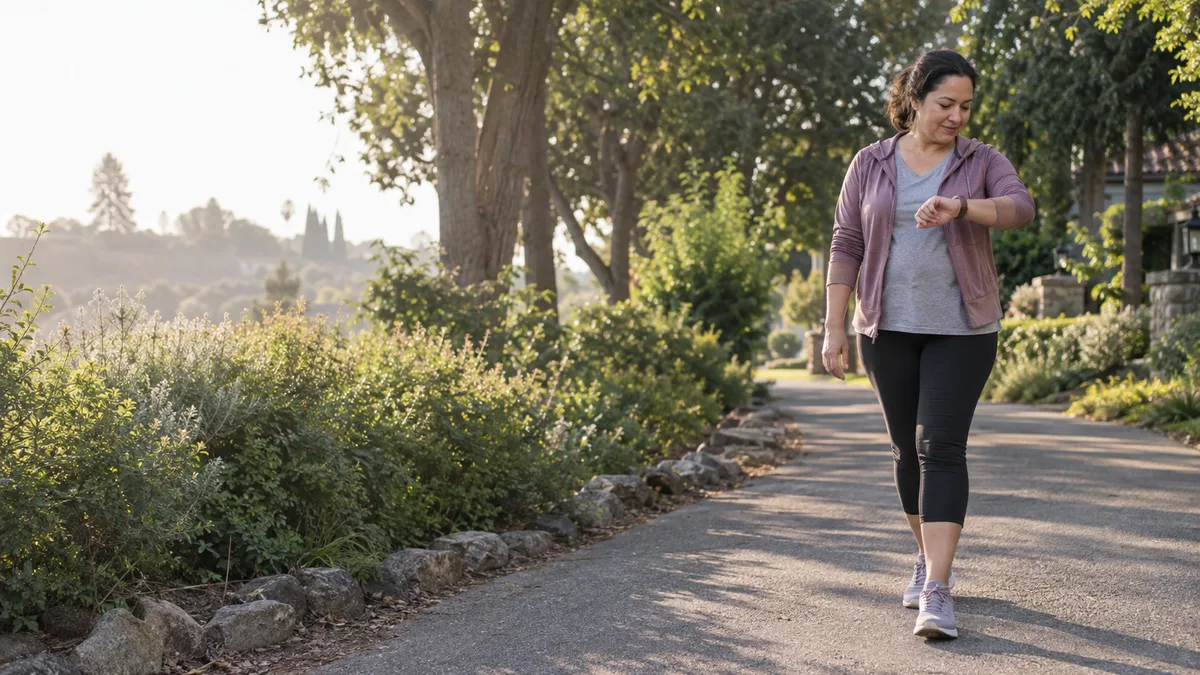
Start below your current comfortable limit, walk on three to five days a week, and increase total weekly minutes gradually. Let how you feel, your pace, any health conditions, and your recovery guide progression — not a universal 10,000-step target that was never based on individual fitness research to begin with.
The 10,000-step figure traces back to a 1960s Japanese pedometer marketing campaign, not a clinical recommendation, which is part of why it feels arbitrary and discouraging to beginners who start well below it.
A Worked Example: Lee’s First Two Weeks
| Week | Minutes per walk | Walks per week | Weekly total |
|---|---|---|---|
| 1 | 12 | 4 (Mon/Wed/Fri/Sat) | 48 minutes |
| 2 | 14 | 4 | 56 minutes |
Adding two minutes to each walk brings the weekly total from 48 to 56 minutes — a 16.7% increase. That pace may be too fast for some people and easy for others; symptoms, terrain, and how recovered you feel between walks matter far more than hitting a specific percentage.
Build the Plan in Six Steps
- Check whether medical advice is appropriate before increasing activity. Especially relevant with an existing heart, joint, or respiratory condition, or after a long period of inactivity.
- Measure a comfortable starting duration on level ground. Walk until it feels like a 6-7 out of 10 effort, then note that time as week one’s baseline.
- Schedule short walks on days you can realistically recover between. Three to five days a week with rest days between beats seven days that quietly become zero after a rough week.
- Track minutes, effort, symptoms, and recovery — not just steps. A phone timer and a one-line note after each walk is enough; no app is required.
- Increase only one variable at a time — time, pace, hills, or frequency. Changing several at once makes it impossible to tell which change caused any new discomfort.
- Use the federal activity guideline as a direction, not a first-week demand. 150 minutes a week is a target to grow into over weeks or months, not a starting requirement.
Reading the Graphic

Follow the path left to right as weeks pass, not top to bottom in one sitting — each stage assumes the previous one has already become comfortable before you add the next variable.
A Four-Week Minute Progression to Copy
| Week | Minutes per walk | Weekly total (4 walks) |
|---|---|---|
| 1 | 10-12 | 40-48 min |
| 2 | 13-15 | 52-60 min |
| 3 | 15-18 | 60-72 min |
| 4 | 18-22 | 72-88 min |
This is a starting template, not a fixed prescription — repeat a week exactly as-is if the previous increase felt harder than a 6-7 out of 10 effort. There’s no penalty for progressing slower than the table suggests.
Common Mistakes to Avoid
- Chasing 10,000 steps regardless of starting ability. A number with no connection to your current fitness level is a discouraging place to start.
- Increasing duration and intensity at the same time. Change one variable per week so you can tell what actually caused any new soreness.
- Ignoring chest pain, dizziness, or unusual shortness of breath. These warrant stopping and seeking medical attention, not pushing through to finish the walk.
- Treating a missed day as a reason to double the next session. Resume at the planned duration; doubling up after a break raises injury risk for little benefit.
The Wellness Habit Planner gives you a simple place to log minutes, effort, and recovery from walk to walk, so the progression above is easy to track without a fitness app.
Product recommendation
Recommended DaveWays Resources
Wellness Habit Planner
Gives you a simple place to log minutes, effort, and recovery from walk to walk, so the progression above is easy to track without a fitness app.
FAQ
Is ten minutes worthwhile?
Some activity is better than none, and shorter bouts can help build consistency.
How fast should I walk?
Use an appropriate effort for your fitness and health; moderate intensity is often described with a talk test.
When should I stop?
Stop and seek appropriate care for concerning symptoms; personalized medical guidance overrides a general plan.
Educational content only. This article does not provide individualized medical advice; consult a qualified professional about your own health circumstances.
Sources: CDC adult physical activity basics and HHS Physical Activity Guidelines.
Join the email list for practical health & wellness worksheets, buying guides, and product updates.